
Understanding Gulf County Releases
A release ends one custodian's physical hold. It does not always mean the person walked into the community with no other legal status. Gulf County Detention Facility may release someone on bond, recognizance, time served, sentence completion, or after dismissal. It may also deliver someone to the Florida Department of Corrections, another jail, the U.S. Marshals Service, or immigration authorities. That handoff ends Gulf County jail custody but starts or continues custody elsewhere.
The agency that carried out the event holds the best proof. The jail's booking and release entries establish when its custody ended. The Gulf County Clerk docket explains the court order or sentence behind that event. FDC records document state-prison movement, release, and supervision. A careful Gulf County release lookup therefore identifies both the releasing custodian and the destination.
- Discharge
- An agency's formal end of custody or supervision.
- Time served
- A sentence satisfied by time already spent in custody.
- Detainer
- A request or legal hold that can send a person to another custodian instead of the community.
- Expungement
- A court-ordered restriction on access to qualifying records, not an inference drawn from an empty search.
Gulf County Release Paths
The words in a docket or booking record matter. A bond order permits release after its conditions are met, while the jail entry records the actual departure. A transfer is not the same as freedom. Likewise, probation often begins without a state-prison term, while parole is a narrow state process for eligible cases. The next official system depends on the recorded path.
| Recorded path | Meaning | Next place to verify |
|---|---|---|
| Bond or recognizance | Release after court-set terms are met | Jail release entry and court docket |
| Time served or sentence complete | Custodial term has ended | Release record and judgment |
| Dismissal | A charge or count ended without conviction | Clerk disposition, read count by count |
| Probation or community control | Court supervision outside jail | Clerk and FDC supervision search |
| FDC transfer | County custody ended, state custody began | FDC population search |
| Federal or immigration handoff | Another sovereign received custody | BOP, ICE, court, or agency confirmation |
Important: A name disappearing from a Gulf County custody surface is only a lead. Positive release, transfer, or court evidence is needed.
Gulf County Release Record Fields
Gulf County does not expose a public release database with a fixed list of fields. Request the existing booking sheet, release screen, or release log for the identified episode. Ask for maintained fields instead of asking the agency to create a new account of events. The Florida records schedule describes commitment and release lists that can include identity, charge, court, bond, how released, and a returnable date, but it does not prove that Gulf keeps every possible field in one export.
| Field to request | What it can establish |
|---|---|
| Full name and identifiers | Which booking belongs to the person |
| Booking number and date | The custody episode tied to the release |
| Release date and time | When Gulf County custody ended |
| Release method or disposition | Bond, time served, completion, transfer, or another recorded basis |
| Releasing authority | The court, agency, or legal basis directing release |
| Receiving agency or destination | Whether the person entered another custodian's control |
A release field is operational evidence. The clerk's judgment and docket supply legal context, but a bond order or sentence alone may not show the time the person cleared all holds and left the jail.
Request Gulf County Release Records
The Gulf County Sheriff's Office accepts public-record requests through its official records channel. A narrow request is easier to locate and price. Include a full name, a booking number when known, and a short date range. Ask for the record in its existing electronic form. Gulf County does not publish a fixed jail-release-record fee, so request an estimate before work begins.
- Identify the booking by name, approximate booking date, and booking number if known.
- Ask for the existing booking sheet and release entry, including date, time, method, authority, and transfer destination if maintained and public.
- Send the request to GCSO Records by its web route, email, phone, fax, mail, or in person.
- Ask for a cost estimate and native electronic format. Do not ask staff to create a new report or analysis.
- Compare the response with the clerk docket or receiving agency when the record shows a transfer or hold.
418 Cecil G. Costin Sr. Boulevard
Port St. Joe, FL 32456
(850) 227-1115, option 5
publicrecords@gcso.fl.gov
Monday through Friday, 9:00 a.m. to 5:00 p.m. Eastern, except holidays
The Florida public-record fee rules allow authorized copy charges and actual labor costs for extensive work. There is no universal number of days for a response. Florida requires prompt access within a reasonable time and under reasonable conditions.
Gulf County Record Access Limits
Article I, section 24 of the Florida Constitution and Chapter 119 support broad access to government records, subject to exemptions. Juvenile, sealed, expunged, victim, medical, and security information can receive different treatment. The custodian must make that legal review. A blank public result does not establish that a case was sealed or expunged.
Web display and record retention are also different. Florida's GS2 schedule sets a minimum of one anniversary year after release for booking records and commitment and release lists. A sheriff may stop showing an image or post sooner while still retaining an agency record. Pending requests, audits, litigation holds, or another schedule may extend retention. Restricted information should not be rebuilt from cached or unofficial copies.
Note: A court certificate of eligibility does not itself seal a Gulf County case; a court order is required to restrict access.
Gulf County Release Court Proof
Gulf County has an unusually clear court fallback. Begin with the Clerk record-search choices, select the court-record system, and use a case number when possible. Anonymous Public access is available through Gulf's CiviTek court system. Felonies route through Circuit Court. Misdemeanors, criminal traffic, and many early matters route through County Court. Read each count because one arrest can produce more than one charge or case.
The docket may show bond orders, pleas, dismissals, judgments, jail credit, time served, probation, FDC commitments, warrants, violations, and later sentence changes. Inactive files can take a day or so to retrieve. The clerk publishes a $1-per-page mailed judgment-and-sentence service, notes that packets average six to seven pages, and estimates about seven to ten working days. Those terms apply to that court-copy service, not to a jail release log.
The Gulf OCRS access screen shows the public and credentialed routes used for durable case confirmation.
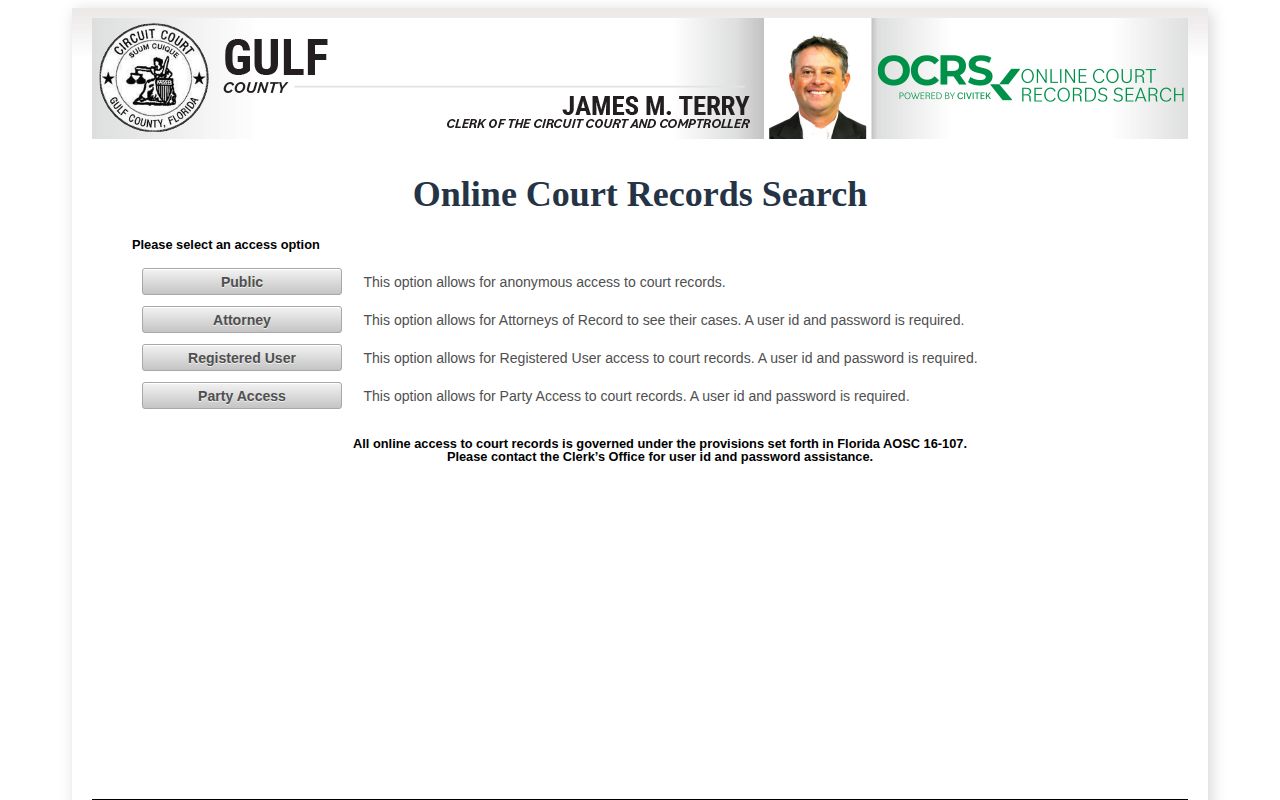
A court disposition explains the legal result, while the jail record remains the source for the physical release timestamp.
Find Released Gulf County Inmates
There is no official Gulf County 24-hour or 72-hour release feed. Start with the custody system that last held the person, then follow any transfer. Use exact identifiers whenever possible because common names, aliases, and multiple bookings can lead to a false match.
- Check the official jail page or call Gulf County Detention Facility for current custody. The sheriff app advertises a current incarcerated-person search, not a release archive.
- Review the GCSO arrest post only for booking context. It lacks a release date, custody flag, bond result, and destination.
- Search the Gulf County court docket for the order, disposition, sentence, or commitment that explains the legal path.
- When the record shows state custody, use FDC's population, release, and supervised-population searches as separate databases.
- When it shows federal or immigration custody, use the corresponding federal locator and confirm the scope of its result.
- If online sources remain unclear, request the jail's existing booking and release record.
Why is a released person gone from the roster? A current-custody list is designed to show who is held now. Once Gulf County custody ends, proof moves to the release entry, court docket, receiving agency, or supervision system.
Florida Search for Gulf Releases
The Florida Corrections Offender Network separates current state prisoners, released state prisoners, supervised people, and absconders. That separation prevents a missing population result from being treated as release proof. The FDC release database does not include a person sentenced only to Gulf County jail or county probation.
| Search field | Use | Key limit |
|---|---|---|
| Last and first name | Broad identity search | Confirm with other identifiers |
| Six-character DC number | Best state-record match | Applies to FDC records |
| Alias option | Checks recorded alternate names | May widen results |
| Photo option | Shows an FDC image when available | Not necessarily the Gulf booking image |
| Result limit | Controls returned matches | Does not change database scope |
FDC says release information updates nightly. The released detail can show a Release Date, DC number, identity, sentence data, custody intervals, aliases, and an FDC photo. The current-population detail uses Current Release Date for a projected state date, so the two labels must not be confused.
The FDC Inmate Release Information Search makes its county-jail exclusion and search choices visible.
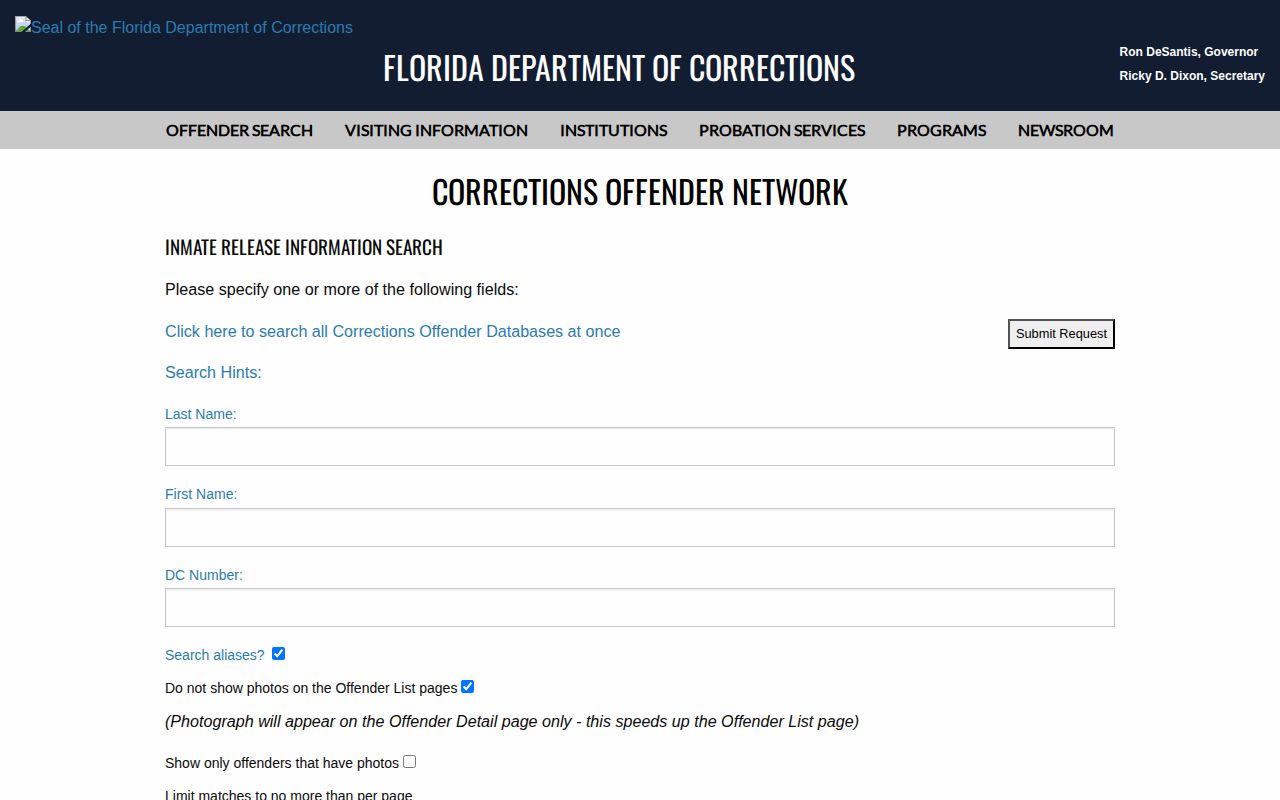
Use the state release result only when FDC held the person. A Gulf County jail release still requires the county record.
Gulf County Recent Release Gap
The official county detention page, GCSO site, state county-jail directory, and sheriff app listings expose no recent-release feed. The GCSO Arrests page is a curated arrest-post surface. At research time it showed names, arrest dates, charges, some agency notes, and images, but it did not show booking numbers, a live custody flag, bond status, release time, release reason, or destination.
Photos are described as displaying for about two weeks. That window is not a custody period, release window, update cadence, or retention rule. A post disappearing cannot prove release. For a true same-day or three-day answer, request the existing release log or export for the exact interval. If the office has no interval report, request the named person's release entry instead.
The official jail page confirms contact details and the absence of a public lookup in the page capture.

That page can route a call, but it should not be presented as an online roster or release list.
Verify Gulf Release Facility Names
Local facility names can mislead an old-record search. The county detention page highlights recent renovations without publishing their scope, completion date, or effect on release processing. Separately, older FDC material names Gulf Correctional Institution Annex and Gulf Forestry Camp, while current directory treatment centers on the Gulf CI complex. An old facility label does not prove current operation or present custody.
Search the person's DC number and custody intervals when an FDC record names a Gulf complex component. If the public state record is unclear, request the movement or release record from FDC Central Records. For county detention, use the jail's release entry and avoid assuming that renovations changed where or how release records are kept.
Gulf County Post-Release Supervision
Release and supervision are distinct. FDC's Supervised Population search can show supervision type, current status, current location, start date, and scheduled termination date for people supervised by FDC. Probation is generally imposed by a court. Parole applies to a limited set of Florida cases and is administered through the Florida Commission on Offender Review. Conditional release is another state mechanism and should not be renamed parole.
Gulf County cases generally route through FDC's Panama City Circuit Office, but the person's Current Location field should be checked first because assignment can differ. An Active Suspense label may mean jail or other custody while an officer continues monitoring. It does not prove that the person is physically free in the community. The separate Gulf County parole and probation record explains how to verify these labels and locate the assigned office.
Gulf Release Alerts and Transfers
Florida VINELink can provide custody-event searches and alerts when the reporting agency supplies the data. Match the identity and feeding agency, then read the literal event text. A release event proves that one custodian reported a release. It does not rule out another hold, transfer, later booking, or supervision. Searching alone does not register an alert.
Federal records require different tools. The BOP Inmate Locator searches by federal numbers or identity and can show Release Date and Location. A past date with no facility, or a RELEASED location, means the person is no longer in BOP custody. The U.S. Marshals Service may hold federal pretrial prisoners in contract facilities and has no comparable public name roster. ICE's locator covers current detainees and certain people released from ICE custody within a limited window. A no-result does not prove release or removal.
A Gulf County entry marked to USMS, BOP, or ICE records a transfer from county custody, not a community release. Confirm through the federal court docket and the receiving agency.
Registry Evidence of Gulf Release
GCSO's embedded FDLE offender map offers a released-first status for a narrow population. The Florida registry can display labels such as Released, Subject to Registration or Supervised by FDC along with an FDLE photo. For a correctly matched registrant, that status can support the fact that confinement ended while a registration duty continues.
The FDLE offender search is not a list of all Gulf County released inmates. It does not establish the exact jail departure time, and an absent result says nothing about a person who has no statutory registration duty. COAST is similarly limited to people with the applicable career-offender designation. Keep both systems within their narrow legal scope.
Gulf Release Status Sources
Each official source answers a different question. Using the wrong one can turn a transfer, supervision record, or stale arrest post into a false release claim.
| Source | Best question | What it cannot prove alone |
|---|---|---|
| Gulf jail contact or record | Did county custody end, and how? | Later state or federal status |
| GCSO app or arrest post | Is there current custody or booking context? | A past release date |
| Gulf Clerk docket | What court action authorized the path? | Actual door-out time |
| FDC population search | Is the person in state prison now? | County-only release |
| FDC release search | Did state-prison custody end? | County-jail-only custody |
| FDC supervision search | Is state community supervision active? | Physical freedom at a given moment |
| BOP or ICE locator | What does that federal custodian report? | All other custodial systems |
Note: A positive record tied to the correct person and custody episode is stronger than absence from any live list.
Gulf County Release Facilities
Five facilities or facility components matter to Gulf County release research. Each has a different operator, population, and confirmation route.
- Gulf County Detention Facility is the county jail. Confirm community release or transfer through the jail record and clerk docket.
- Gulf Correctional Institution is an FDC state prison. Use the statewide population, release, and supervision searches.
- Gulf Correctional Institution Annex is a status-sensitive physical component of the Gulf CI complex. Verify current operation and use FDC records.
- Gulf Forestry Camp is a historical or status-sensitive FDC component. An old record naming it does not prove present custody.
- Bay Regional Juvenile Detention Center serves Gulf County youth through DJJ. Confidential juvenile channels apply instead of adult jail or FDC public searches.
A facility name is the start of the search, not the conclusion. Match the record date, operator, identifier, and destination before describing the event as release.