
Gulf County Parole vs Probation
Florida does not use parole as a catchall name for every type of release. The Florida Commission on Offender Review, or FCOR, makes decisions within its parole, conditional release, conditional medical release, and related authority. The Florida Department of Corrections, or FDC, operates community supervision. A court may order probation without a state-prison term or after a period of custody. Most people serving modern Florida prison sentences are not automatically parole eligible.
The source of the supervision matters. The judgment and sentence show what a court imposed. A Commission Action records an FCOR decision. FDC's operational record shows the supervision type, current status, assigned location, beginning date, and scheduled termination date. Those sources should agree before a status is treated as settled.
| Status | Decision source | Best verification record |
|---|---|---|
| Parole | FCOR under the narrow statutory framework | Commission Action plus FDC supervised-population detail |
| Probation | Court judgment or later order | Judgment and sentence plus the applicable supervision record |
| Conditional release | Florida law and FCOR action | Commission record and FDC supervision detail |
| Community control | Court order | Court file and FDC record when FDC supervises the case |
| Pretrial release | Criminal court | Bond or release order and Gulf Clerk docket |
- Parole
- Supervised release authorized within Florida's limited parole framework before the sentence has fully expired.
- Probation
- Court-ordered supervision that may be imposed instead of, or after, a custodial term.
- Discharge
- The formal end of the supervision obligation, shown by the controlling agency or court record.
- Absconder
- A person whom FDC reports has stopped making himself or herself available for supervision.
Verify Gulf County Post-Release Supervision
Begin with the correct FDC database, not the current prison population alone. The Supervised Population Information Search accepts a name or DC number, with alias and photo options. A six-character DC number is the strongest public identity key. Name-only matches should be checked against the birth date, offense, county, and other displayed facts. FDC refreshes most supervision data weekly, while termination dates and location changes update nightly.
- Search by DC number when known. Otherwise enter the person's first and last name and use the alias option when a committed name may differ.
- Open the matching detail only after comparing the available identity fields. Similar names are not enough.
- Record the literal Supervision Type, Current Status, Current Location, Supervision Begin Date, and Scheduled Termination Date.
- Check the court file through the Gulf County Clerk record search for the judgment, sentence, violation order, or termination entry.
- If parole or conditional release is involved, obtain the Commission Action rather than relying on a calendar or meeting agenda.
- Contact the office shown as Current Location when a public field is unclear. Assignment may differ from the usual Gulf County office.
An empty state result has limits. FDC expressly excludes county probation from its public release database, and locally administered misdemeanor supervision may not appear in the statewide supervised-population search. The Gulf Clerk docket is therefore essential when the sentence stayed within county jurisdiction. A current jail record answers physical custody, while an FDC supervision result answers legal oversight outside prison. Neither should be silently substituted for the other.
The official supervised-population search shows the fields used in this verification path.
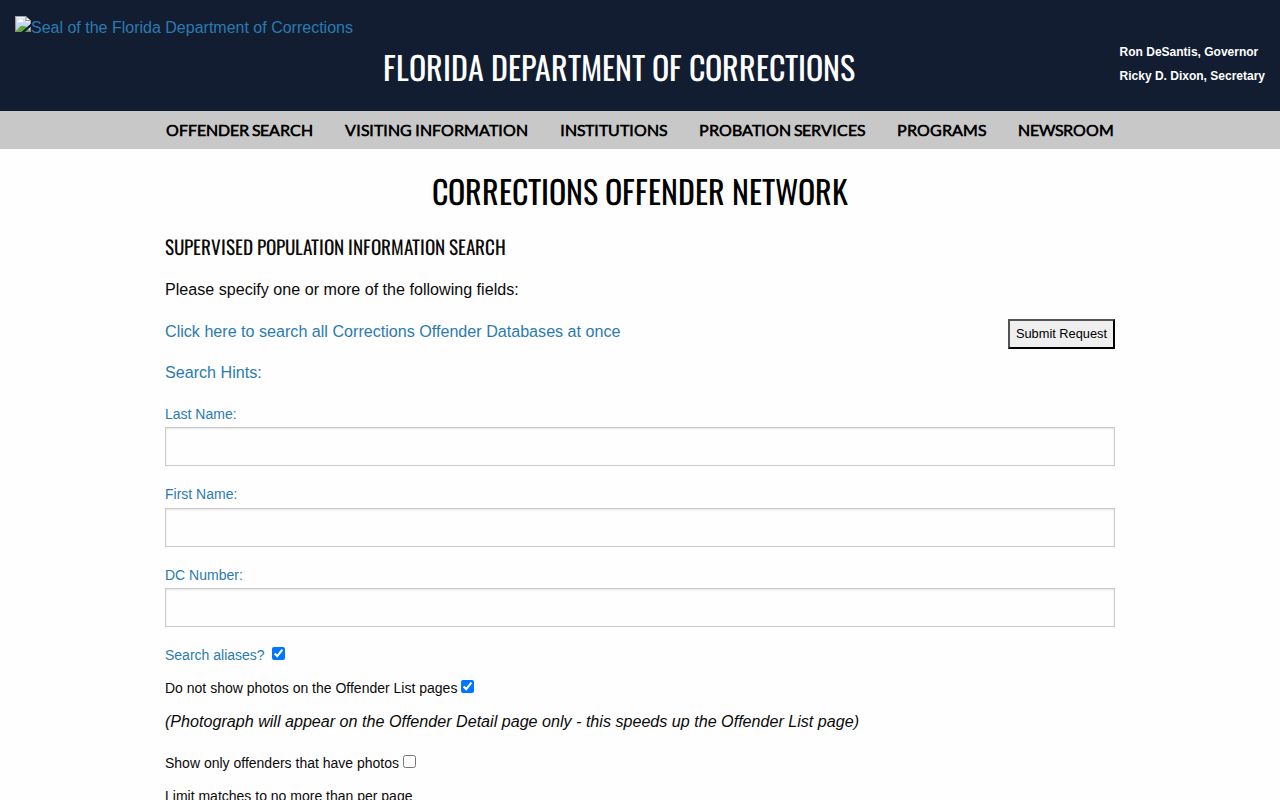
Its separate scope helps prevent a supervision date from being mistaken for a prison release date.
Note: A state supervision result may change after its refresh, so save the access date and confirm conflicts with the record custodian.
Gulf County Supervision Office Route
Adult FDC supervision for Gulf County normally routes through the Panama City Circuit Office, which also serves Bay, Calhoun, Holmes, Jackson, and Washington Counties. That regional role does not prove that every Gulf County case is assigned there. Cases may move, a specialized unit may apply, or supervision may occur through an interstate compact. Check the person's Current Location field first, then contact the listed office with the DC number and a narrow public-status question.
FDC Panama City Circuit Office
3621 West Highway 390
Panama City, FL 32405
(850) 872-7590
Fax: (850) 872-7594
Email: panamacity.cir@fdc.myflorida.com
FDC's Probation and Parole Field Services can also route state community-supervision record questions at (850) 717-3444 or co-supervision@fdc.myflorida.com. Public verification should stay at the level of status and assignment. Private residence data, reporting instructions, and appointment details are not part of a routine records check.
Gulf County Absconder Record Checks
A violation is not established merely because a person misses an expected contact or disappears from a public result. Conditions come from the court order, Commission Action, or supervision record. A formal violation can lead to a warrant, revocation proceeding, modification, custody, or another lawful response. The controlling docket and agency file identify which step actually occurred.
FDC maintains a separate Absconder/Fugitive Information Search. If a verified match appears, accurate wording is that FDC reported absconder or fugitive status on the access date. That entry does not prove a new conviction and does not provide a known present location. The Absconder Unit takes information at (850) 717-3475 on weekdays from 8:00 a.m. to 5:00 p.m.; urgent location information belongs with law enforcement.
The official FDC absconder search is a distinct supervision channel, as shown in the source search screen.
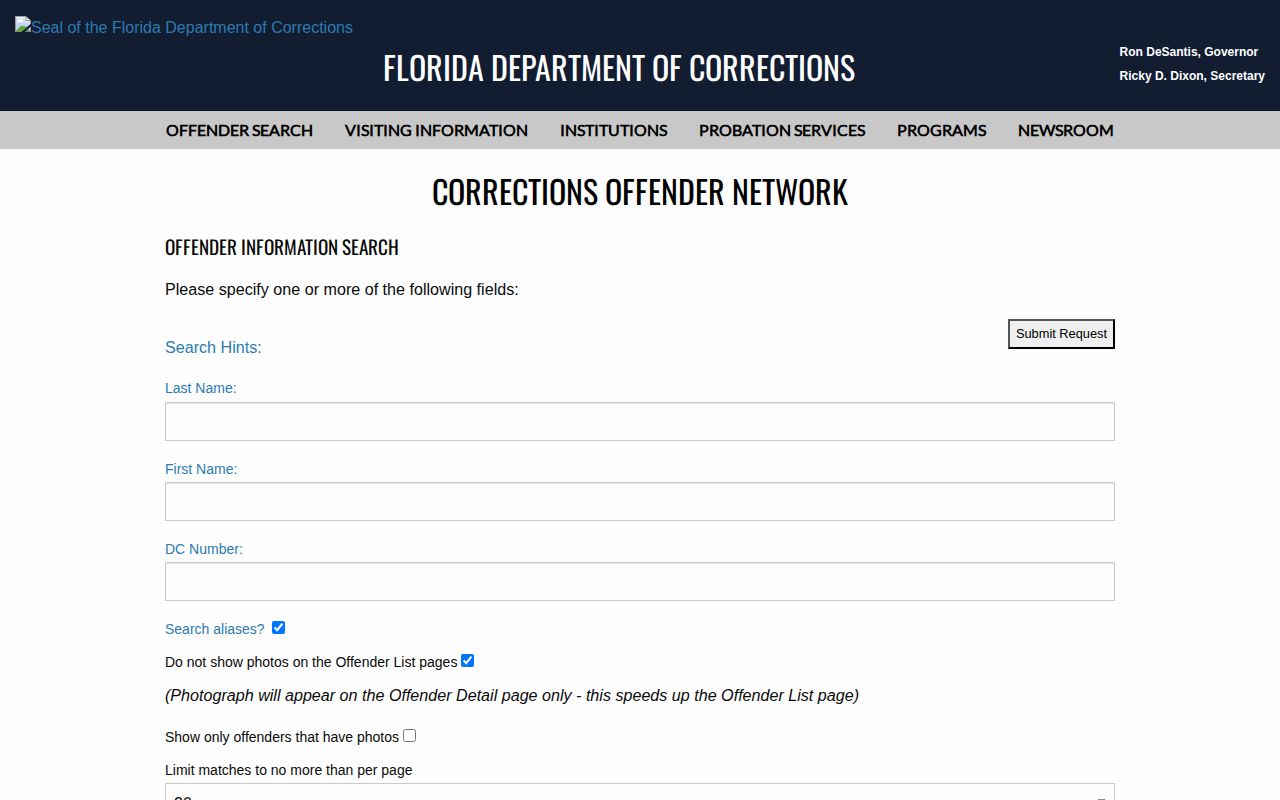
Keeping this database separate avoids treating an absconder entry as a current jail locator.
Gulf County Wanted Page Limits
The Gulf County Sheriff's Office also maintains an official wanted-persons page. On the research date, it displayed only “Check Back Later” and no named list. That blank screen is not a warrant clearance, and it is not a historical archive. A local warrant may still appear in the responsible court or agency record even when the web page has no current posting.
Use the sheriff page as a current notice surface only. State-supervision absconder status belongs in FDC's separate database. Court-issued warrant and violation events belong in the clerk docket. When the sources differ, retain the actual labels and dates. Do not merge them into a claim that the person is free, wanted, or in custody without positive support.
Note: A blank wanted-persons page cannot establish that Gulf County has no active warrants for the person being checked.
Gulf County Parole Decision Records
The FCOR Commission Voting Schedule is useful for finding a scheduled vote or teleconference. Its monthly calendar often contains frequent sessions and links to detailed agendas. Agenda fields can include name, DC number, category, panel or full group, county, offense, and case number. Categories such as effective interview, parole final hearing, or conditional release review describe the matter before the Commission. They do not state the outcome.
The published calendar and cadence can be seen at the official schedule source.
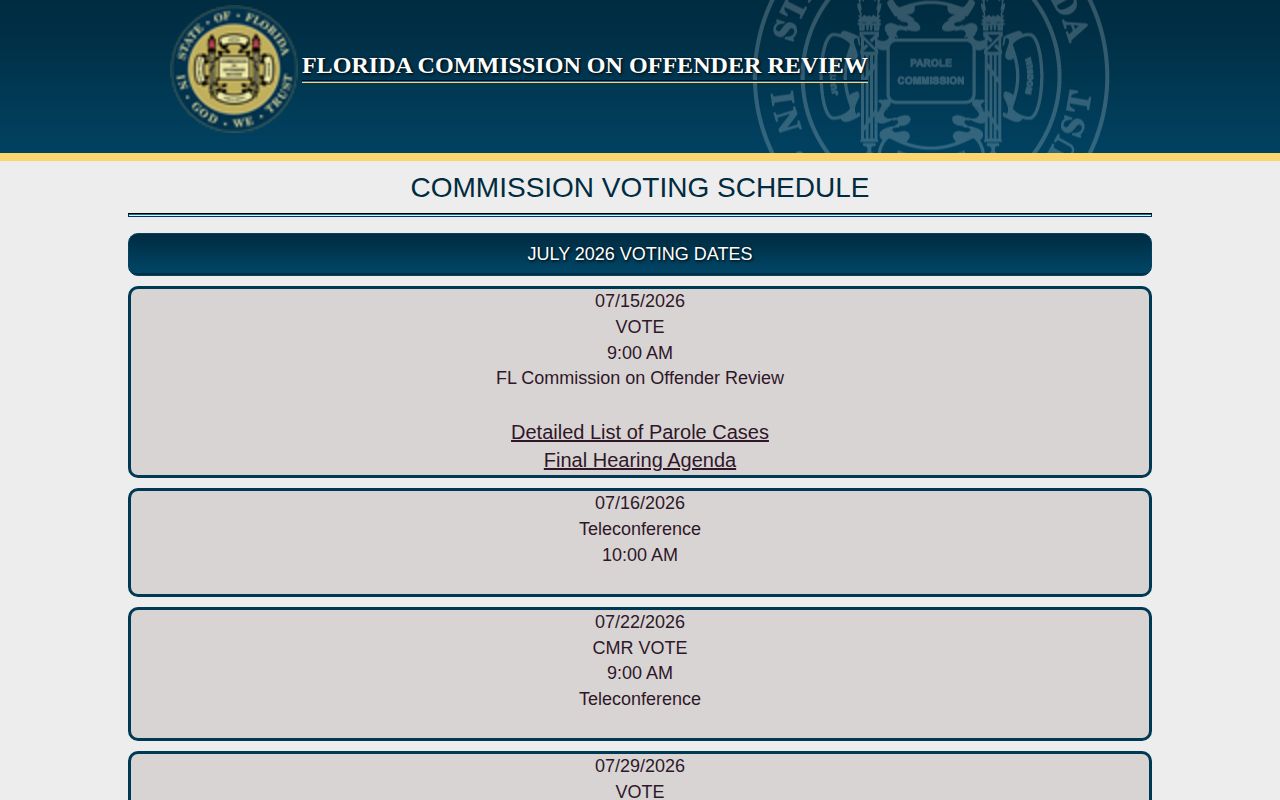
The schedule should be paired with a final Commission Action before anyone describes a Gulf County parole result.
No public post-vote parole-decision search was found. Request the Commission Action or order from the Office of Commission Clerk using the person's name, DC number, meeting date, and case number. The office is at 4070 Esplanade Way, Tallahassee, FL 32399-2450, and its telephone is (850) 488-1293. A presumptive date may be set, affirmed, or changed. An effective date may also be delayed for a release plan, new facts, conduct, or verification. Terms such as denied, deferred, or rescinded should appear only when the action itself uses them.
Eligibility is narrow and depends on historical law. FDC and FCOR materials explain that Florida generally abolished parole for offenses committed on or after October 1, 1983, subject to limited historical capital-felony exceptions. Florida Statutes § 947.16 governs parole interview timing, but an interview date does not resolve eligibility or promise release. Offense date, classification, and the controlling sentence must be reviewed by FCOR or FDC. Chapter 947 also permits later review and modification within the Commission process, which is why an agenda and a presumptive date are not final proof that someone left custody.
How Gulf County Supervision Ends
Release from a jail or prison and discharge from supervision are separate events. A person can be outside prison while probation, parole, conditional release, or community control continues. The FDC detail's Scheduled Termination Date may be prospective. It should not be reported as a completed discharge until the current status and record chronology support that reading.
For state supervision, compare the released-person detail, supervised-population detail, and any final termination or discharge record. For court probation, use the Gulf County judgment, later modification, and order ending the case or supervision. For parole and related FCOR authority, use the Commission Action. The broader Gulf County released inmate search and records path explains how the jail release entry and court docket fit beside these supervision records.
Florida public-record access under Chapter 119 is broad but subject to lawful exemptions. A request should identify the existing record by person, DC or case number, date range, and document type. It should not ask an agency to create a new conclusion. A certified court order or agency discharge record is more durable than an old portal screenshot, especially when a scheduled date later changed.