
Gulf County 72-Hour Release Records
Neither the Gulf County government page nor GCSO publishes an official list of jail releases during the prior 72 hours. The state county-jail directory also supplies no inmate-search link for Gulf County. This verified gap means there is no public three-day screen with a documented cadence, cutoff time, retention rule, or fixed result fields. A requester must define the interval and seek an existing release log or booking-and-release entry.
The three-day window is a records range, not a legal category. Count back from the exact end time and state the time zone. If the goal is to capture Friday evening through Monday morning, write those start and end timestamps rather than saying “over the weekend.” A precise request reduces ambiguity when office closures, holidays, or after-hours processing cross calendar dates.
The official detention-facility page identifies the Gulf County jail and provides its contact route.
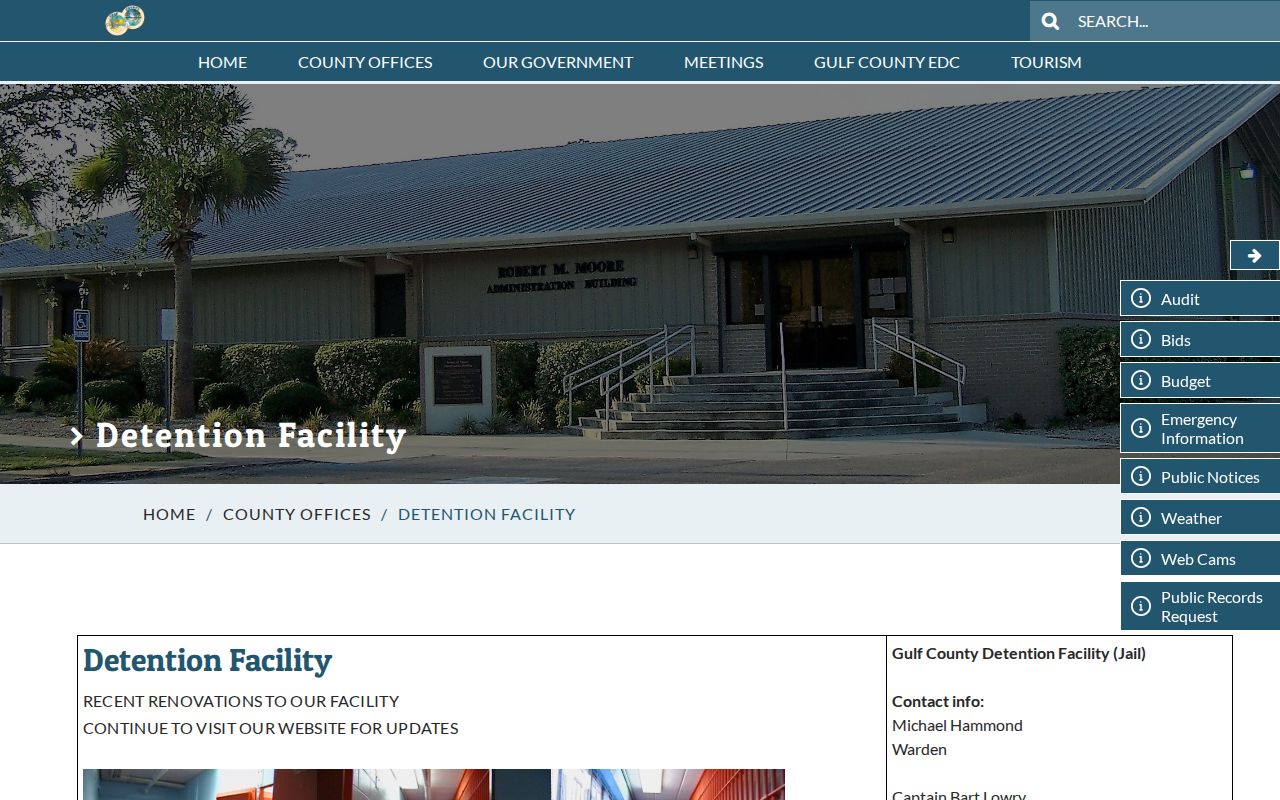
The page has no three-day release module. Its contact details are the starting point for a maintained-record request.
Check Gulf County 72-Hour Releases
Begin with the jail because it owns the physical booking and departure event. The court owns the order, judgment, or docket entry that may explain the legal basis. Use both when the exact exit and the case outcome matter. The same name can belong to more than one person, and one person can have several cases or custody episodes.
- Set the exact beginning and ending timestamps for the 72-hour interval, including Eastern time.
- Call the Gulf County Detention Facility at (850) 227-1124 and ask whether the named person remains in county custody.
- Ask whether an existing release log or electronic export covers the period. Do not demand a new report or analysis.
- Send a focused request to GCSO Records if the information is not available by telephone.
- Search the Gulf County Clerk docket for bond, recognizance, dismissal, sentence, jail credit, warrant, or FDC commitment entries.
- Follow any transfer to the receiving system. A transfer out of Gulf County custody is not necessarily a community release.
Use full name, date of birth if lawfully known, approximate booking date, booking number, charge, and case number to narrow the request. If only a phone response is available, treat it as a lead until the jail entry or another agency record confirms what occurred. The Gulf County 24-Hour Release List process is the better fit when only the latest same-day period matters.
Note: A court order can authorize release before jail processing is complete, so compare the docket time with the actual departure entry.
Gulf County 72-Hour Release Fields
Gulf County does not expose a public 72-hour field table. The fields below are the specific items to request from an existing log or release record. They distinguish identity, the custody episode, the act that ended local detention, and the person's destination. Some material may be redacted under Florida law.
| Requested field | Why it matters |
|---|---|
| Name, aliases, birth date | Matches the record to the intended person |
| Booking number and date | Separates the relevant jail episode from other arrests |
| Release date and time | Places departure inside or outside the three-day interval |
| Release type or method | Shows the recorded basis, such as bond or time served |
| Releasing court or authority | Connects the jail event to its legal source |
| Transfer destination | Separates a new custodian from return to the community |
| Charge and case number | Links the episode with the correct clerk docket |
“Bonded out” means the person left that jail episode while the criminal case continued. “Sentence expired” or “time served” can end the custodial term without ending another case, supervision, registration duty, or monetary obligation. “Released to FDC,” “released to ICE,” “released to USMS,” and “transferred” mean custody changed hands.
Gulf County Weekend Release Checks
A 72-hour range is useful because it crosses more than one business day. A weekend arrest, bond order, or sentence-completion event may be recorded while public counters are closed. Holidays can also delay the practical step of obtaining a copy. None of that proves the jail held someone longer than authorized. It only means the public verification path may finish later than the physical event.
Search the docket for the court event, then ask the jail for the departure record. If Monday's search does not show what was expected, preserve the date and time of the query and recheck after agency systems update. FDC says its separate state release database updates nightly. Gulf County has not published a comparable cadence for county-jail records, so no update promise should be inferred.
For a named person, a broader Gulf County released inmate lookup can resolve county, state, supervision, and federal paths after the three-day interval ends. A current county roster, if later added, would answer whether someone remains there. It would not replace the signed release entry.
Gulf County Arrest Feed Limits
The GCSO Arrests page is a curated arrest-post feed, not a 72-hour custody or release roster. It shows items such as name, arrest date, charge, image, and sometimes the arresting agency. It omits live custody status, booking number, bond result, release date and time, release reason, and destination.
The captured posts demonstrate the difference. GCSO says arrest photos display for about two weeks, which is longer than a 72-hour search window. That display period does not prove the subject stayed in custody, and disappearance does not prove release. It is also not the retention period for the underlying booking and release record.
- Custody roster
- A current list of people held by an agency.
- Release log
- A maintained record of departures during a defined interval.
- Transfer
- A move from one custodian to another.
- Release authority
- The court order, sentence event, bond, or other recorded basis for departure.
Request Gulf County Release Logs
GCSO Records accepts requests at (850) 227-1115 option 5, by email at publicrecords@gcso.fl.gov, by fax at (850) 227-2097, by mail, and in person. The office is at 418 Cecil G. Costin Sr. Boulevard, Port St. Joe, FL 32456. Hours are Monday through Friday from 9:00 a.m. to 5:00 p.m. Eastern, except holidays.
A useful request asks for “the existing release log or export for [start timestamp] through [end timestamp], in its native electronic format if available, including release date and time, method, authority, and destination or receiving agency.” If no interval record exists, ask for the named person's booking sheet and release entry. The official GCSO request page says fees are evaluated individually and an estimate is supplied when required. Payment precedes production.
The page's seven-to-ten-business-day statement applies to traffic-crash reports. It is not a published turnaround for a jail release log. Florida Chapter 119 generally provides access to existing public records; it does not require the custodian to create a rolling 72-hour webpage or explain events in a new narrative.
Save the agency response and the interval used. If no period log exists, switch to a person-specific request for the booking sheet, release entry, and transfer or destination field. A response that identifies the wrong custodian should guide the next request to the jail, clerk, or receiving agency. A redaction or exemption is also different from a statement that no record exists. Keeping those answers distinct prevents an incomplete response from being treated as proof that no release occurred during the three-day span.
Note: Ask for a native export when one exists because it can preserve timestamps and destination fields better than a copied screenshot.
Verify Gulf County Release Destinations
A county record may show community release, state transfer, federal pickup, immigration custody, or movement to another jail. Each path has its own confirming source. Use FDC's Population search when a person was committed to state prison. Its separate Release search covers people released or scheduled for release from FDC and excludes county-only sentences. Run the DC number through the Supervised Population search when post-prison supervision may continue.
Use the Bureau of Prisons locator for a federal sentence. Federal pretrial custody may involve the U.S. Marshals Service and may not appear as a complete BOP record. ICE's locator addresses current immigration detention and limited recent information; a no-result is not a release certificate. VINELink can relay events from participating agencies, but coverage and timing depend on the reporting custodian.
County release and state discharge are not interchangeable. The jail record answers when Gulf County custody ended. A receiving system answers what happened next. The clerk docket supplies durable legal context after a short web display or app entry has changed.