
Bay Regional Youth Detention Role
Florida DJJ's official facility page identifies Bay Regional Juvenile Detention Center as a secure regional center in Panama City. It serves Bay, Calhoun, Gulf, Holmes, Jackson, and Washington Counties. A Gulf County youth can therefore be held at this Bay County location through the regional juvenile system.
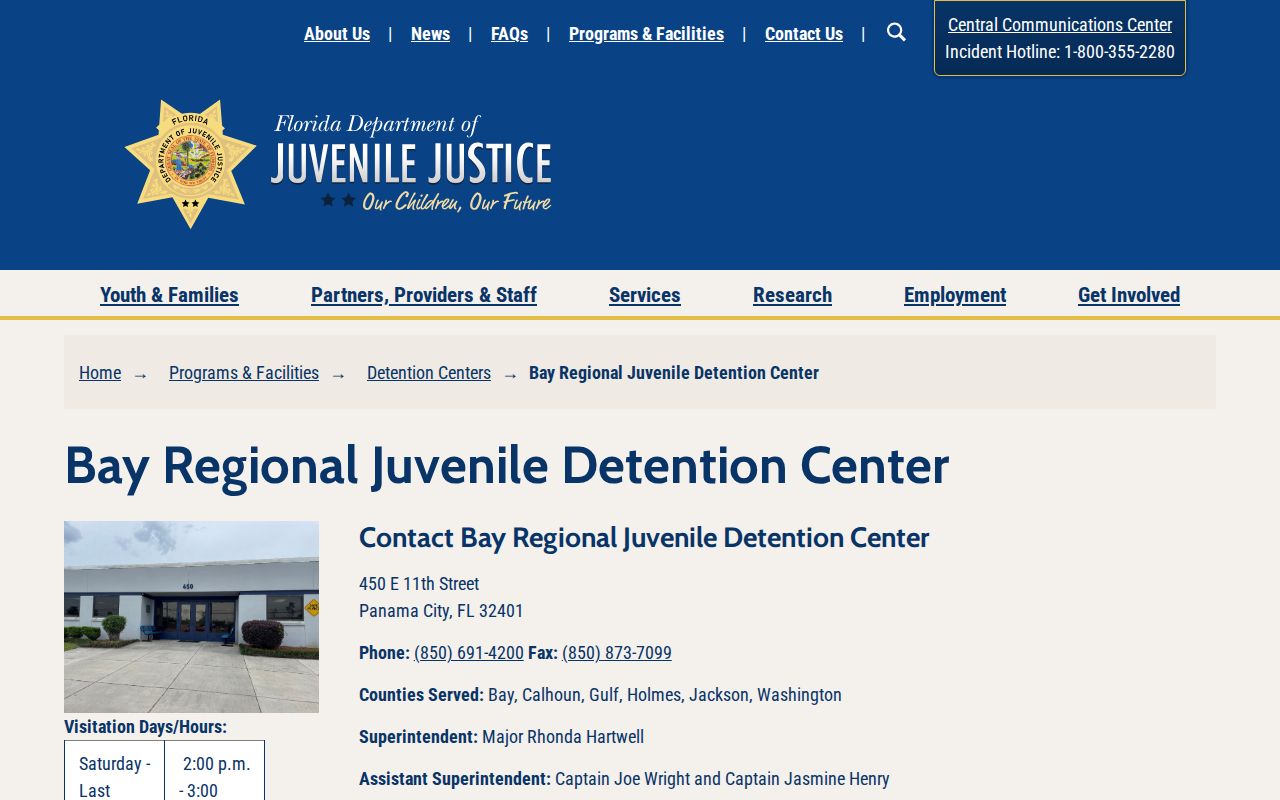
The official page confirms the center's identity and regional service area. It should not be read as an adult jail roster or an open youth release feed.
Secure juvenile detention is different from the Gulf County Detention Facility and from FDC state prison. Adult GCSO arrest posts do not establish a youth's detention or release. FDC's adult offender network is also not the substitute for a DJJ case. The agency, court division, and confidentiality rules must match the youth matter.
Bay Regional Youth Release Paths
A youth can leave secure detention through an authorized release, adjudication or disposition, or movement to a commitment placement. These events do not all mean the same thing. A release ends the detention stay under the applicable authority. A disposition is the juvenile court's decision about the case. A commitment placement moves the youth into a different DJJ setting rather than returning the youth to ordinary community status.
| Event | What to confirm | Correct source |
|---|---|---|
| Release from detention | Date, authority, and any next reporting step | DJJ facility, assigned probation, juvenile court |
| Court disposition | Order and case outcome, subject to access limits | Gulf County juvenile court or authorized DJJ channel |
| Commitment placement | That custody or placement changed rather than ended | DJJ case and placement channels |
| Probation or intervention | Assigned office and current case direction | DJJ probation and community intervention |
A missing name in an adult database cannot decide among these paths. Juvenile confidentiality is not a data flaw. It is a legal boundary that affects what an agency or clerk may disclose and to whom. Ask the responsible office what proof of identity, relationship, authority, or case information is needed for the request.
Confirm Bay Regional Youth Release
Start with the official juvenile system and the exact youth case. Use the youth's legal name, case number if known, referring county, approximate detention date, and the identity or authority the agency requires. Do not seek a public adult-style roster or infer status from an unrelated search result.
- Call Bay Regional Juvenile Detention Center at (850) 691-4200 for facility routing and permitted status information.
- Identify Gulf County as the referring or case county when that is known.
- Contact the assigned DJJ probation or community-intervention office for the authorized release, placement, probation, or aftercare path.
- Use the Gulf County juvenile court channel for the disposition or order, subject to confidentiality and access restrictions.
- If one office cannot disclose the record, ask which custodian holds it and what authority is needed rather than switching to an adult database.
The release and the court order can occur at different stages. A court event may authorize what happens next, while DJJ records the movement or detention departure. Pair those sources when the actual transition and legal basis both matter. The Gulf County released inmate search overview distinguishes the county jail, state prison, and juvenile paths, but the juvenile channel remains restricted.
Note: A no-disclosure response may reflect juvenile confidentiality, not proof that the youth was never detained or has been released.
Bay Regional Release Contact
The center is the direct facility contact for routing questions about a secure detention stay. Its official DJJ listing supplies the address and telephone number. No public roster, release-feed cadence, general records-counter hours, or facility release fee schedule was documented in the Gulf research.
Bay Regional Juvenile Detention Center450 E. 11th Street
Panama City, FL 32401
Phone: (850) 691-4200
Fax: (850) 873-7099
Operator: Florida Department of Juvenile Justice
Call for permitted status and custodian routing.
Ask a narrow question. State that the matter concerns a Gulf County youth and identify the approximate detention period or case. The center may direct the caller to probation, a court contact, or another authorized DJJ unit. That routing is more reliable than calling Gulf County's adult jail, which manages a different population and record system.
- Secure detention
- A DJJ detention setting while the juvenile process proceeds.
- Disposition
- The juvenile court's case decision or ordered outcome.
- Commitment placement
- A DJJ placement following the applicable juvenile process, not an adult prison sentence.
- Aftercare
- Post-placement support or oversight handled through the juvenile system when applicable.
Gulf Youth Probation Release Follow-Up
DJJ's Gulf County Probation and Community Intervention Program is a key local follow-up route even though its office is also in Panama City. The program handles Gulf County juvenile probation and intervention work. It is separate from FDC adult probation and from the Florida Commission on Offender Review.
The official DJJ Gulf County probation page identifies the program and its contact details.
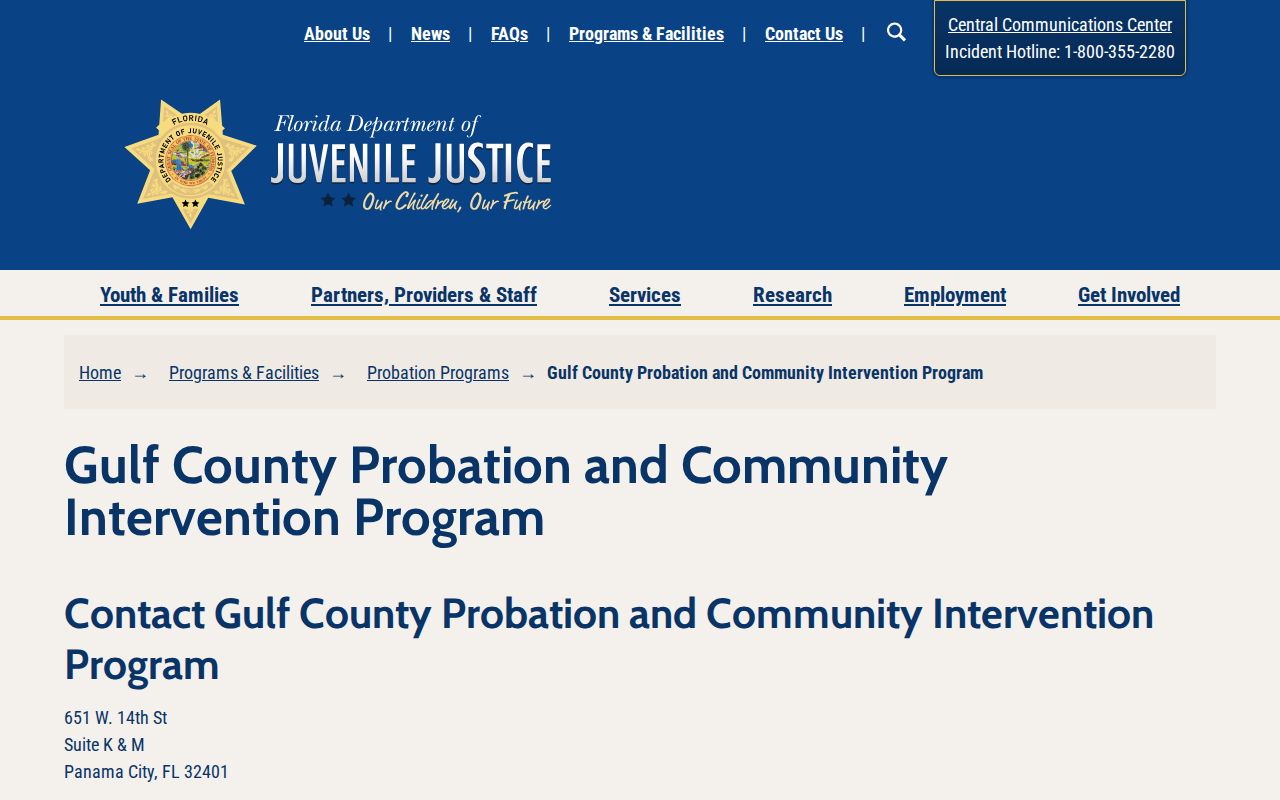
The captured program page supports the Gulf-specific probation route after detention. It does not make case details public or replace the facility's movement record.
DJJ Gulf County Probation and Community Intervention Program651 W. 14th Street, Suites K & M
Panama City, FL 32401
Phone: (850) 872-7630
Contact the program when permitted information is needed about the assigned juvenile probation path, community intervention, release follow-up, or the correct case office. First verify that the program has the case. A regional center can serve several counties, and assignment depends on the youth's matter rather than the facility's street address alone.
Gulf Juvenile Release Court Records
The Gulf County Clerk and Fourteenth Judicial Circuit supply the court side of a Gulf juvenile matter. The Port St. Joe clerk office lists extension 2305 for juvenile delinquency along with misdemeanor and traffic matters. The office is at 1000 Cecil G. Costin Sr. Boulevard, Room 148, Port St. Joe, FL 32456, with telephone numbers (850) 229-6112 and (850) 639-5068. Published hours are Monday through Friday, 9:00 a.m. to 5:00 p.m. Eastern.
Juvenile delinquency records and other exempt or confidential records receive special treatment under Florida law. Chapter 119 creates public-record rights but incorporates exemptions. The clerk or DJJ must review the request and determine access. A public name search that returns nothing cannot prove expungement, release, or lack of a case.
When authorized to request a court item, use the case number and document title or date if known. Ask for the disposition or relevant order rather than a broad file dump. The court record can establish the ordered outcome. It normally does not replace DJJ's record of when the youth physically left secure detention or moved to another placement.
Sealed, expunged, and confidential records must be respected. Do not try to reconstruct a restricted youth matter from cached pages or unofficial copies. A restriction is part of the correct legal answer, not a reason to route the search through adult custody tools.
Bay Regional Adult Search Limits
GCSO Arrests is an adult-oriented local arrest-post surface and does not function as the Bay Regional youth roster. The Gulf County sheriff app advertises a current search for people incarcerated at the county detention facility, a different jail. Neither source should be used to confirm a youth's release or placement from Bay Regional Juvenile Detention Center.
FDC's Inmate Population, Inmate Release, and Supervised Population searches cover Florida adult corrections records within their stated scopes. They expressly do not become juvenile DJJ databases merely because the youth matter arose in Gulf County. An empty FDC result has no value as proof of a Bay Regional release.
The same limit applies to public recent-release pages. Gulf County publishes no official 24-hour or 72-hour adult jail release feed, and even such a feed would not override juvenile confidentiality. The proper chain stays with Bay Regional, DJJ probation or intervention, and the Gulf juvenile court.
| System | Use for Bay Regional release? |
|---|---|
| Bay Regional / DJJ | Yes, subject to authority and confidentiality |
| Gulf juvenile court | Yes, for permitted court orders and disposition |
| Gulf County adult jail or GCSO app | No, different facility and population |
| FDC adult offender network | No, different corrections system |
Note: Use the youth's case county and assigned DJJ office, not the regional center's county alone, to find the right follow-up channel.
Bay Regional Release Record Boundaries
A useful youth release answer distinguishes the secure detention departure, the juvenile court's disposition, any commitment placement, and probation or intervention follow-up. One record may not contain all four. Request only the item the responsible custodian maintains and may lawfully disclose.
Florida public-record law does not erase confidentiality rules. It also does not require an agency to write a new account of a youth's case. A narrow request can identify the name, case number, date range, and record sought, while allowing DJJ or the clerk to state what access or verification is required. Do not ask the agency to create an adult-style release list.
Accuracy requires restraint. The center's 30-bed capacity describes the facility, not the number of Gulf County youth there at a given time. Its six-county service area explains why a Gulf case can be routed to Panama City, but it does not show a specific youth's assignment. The official case and facility contacts must supply that link.
When information cannot lawfully be disclosed, record the office contacted, date, and the stated access limit. Do not convert the limit into a custody claim. The correct result may be that only an authorized person can confirm the youth's release, placement, or current DJJ status.