
Gulf County Projected vs Actual
A projected date looks forward. An actual release date records a completed departure from a named custodian. FDC uses the public label Current Release Date on a current-inmate detail and the statutory term tentative release date for the date produced after gain time granted or forfeited is applied. Once a state release has occurred, the separate released-person detail uses the retrospective label Release Date and may show Date In-Custody and Date Out-Custody intervals.
A Gulf County Detention Facility detainee awaiting trial is different. Bond, recognizance, dismissal, a court order, or transfer can determine when the jail episode changes. There may be no sentence from which to calculate a date. A sentenced county-jail inmate may have a jail calculation based on the judgment, credited time, and applicable local good-conduct rules, but that date is not the FDC Current Release Date.
A missing name from a current roster is not an actual release record. Transfer to FDC, another jail, a federal custodian, or an immigration hold can also end local display. Follow the receiving system before describing the person as back in the community.
Find a Gulf County Projected Date
Start with the custody system, not a broad name search. Gulf Correctional Institution and its historical or status-sensitive components are state-prison facilities. The Gulf County Detention Facility is the county jail. Their records, sentence rules, and release screens are different. A DC number is the strongest public key for an FDC record; a booking number or case number helps with a county episode.
- Determine whether the person is held by Gulf County or FDC. Use the most recent agency record and do not rely on an old facility name alone.
- For a current state prisoner, open the FDC Inmate Population Information Search. Search by the six-character DC number when possible.
- Open the verified detail and copy the exact Current Release Date label along with Current Facility, Current Custody, and Confinement Status.
- For a county-jail case, check the Gulf Clerk criminal docket for the judgment, sentence, jail credit, bond, and later orders.
- Ask the Gulf County Detention Facility for the public jail calculation or existing release-related record when the court papers do not answer the timing question.
- After the event, check the FDC Release Information detail or county release entry for the actual recorded departure.
FDC says most current-population information refreshes weekly, while release dates and location changes update nightly. The public warning matters because a lawful recalculation can occur between checks. The county jail publishes no official online projected-release field in the research. Its telephone is (850) 227-1124, and a focused records request should identify the person, booking episode, case number when known, and the existing field or calculation sought.
The official current-population search displays the update warning and search choices.
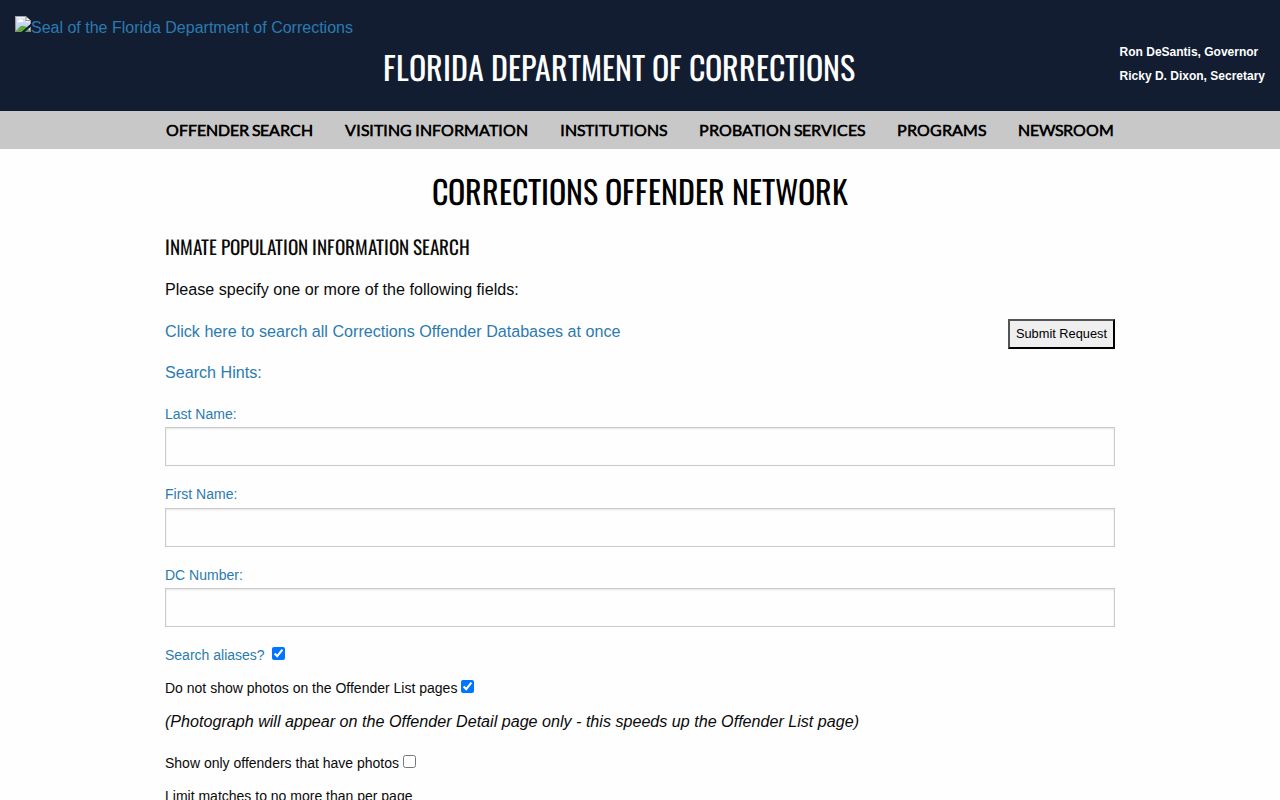
The current-population route belongs to state prisoners, not people sentenced only to Gulf County jail.
Note: Save the access date with any projected date because FDC can update release and location fields after a lawful change.
Gulf County FDC Release Fields
The public current-inmate detail supplies more context than a date alone. It can show Initial Receipt Date, Current Facility, Current Custody, and Confinement Status beside Current Release Date. A life sentence may instead display “SENTENCED TO LIFE.” That label is not an arithmetic date and should not be turned into one.
| FDC field | What it establishes |
|---|---|
| DC Number | The six-character state corrections identity key |
| Initial Receipt Date | When FDC first received the person for the displayed state custody history |
| Current Facility | The institution FDC presently reports, subject to data updates |
| Current Custody | The custody classification shown by FDC, not a release mechanism |
| Confinement Status | The current state-confinement label on the detail |
| Current Release Date | The prospective public field, which may change before release |
| Release Date | The retrospective label on the separate released-person detail |
The public FDC example shows those current-detail labels together.
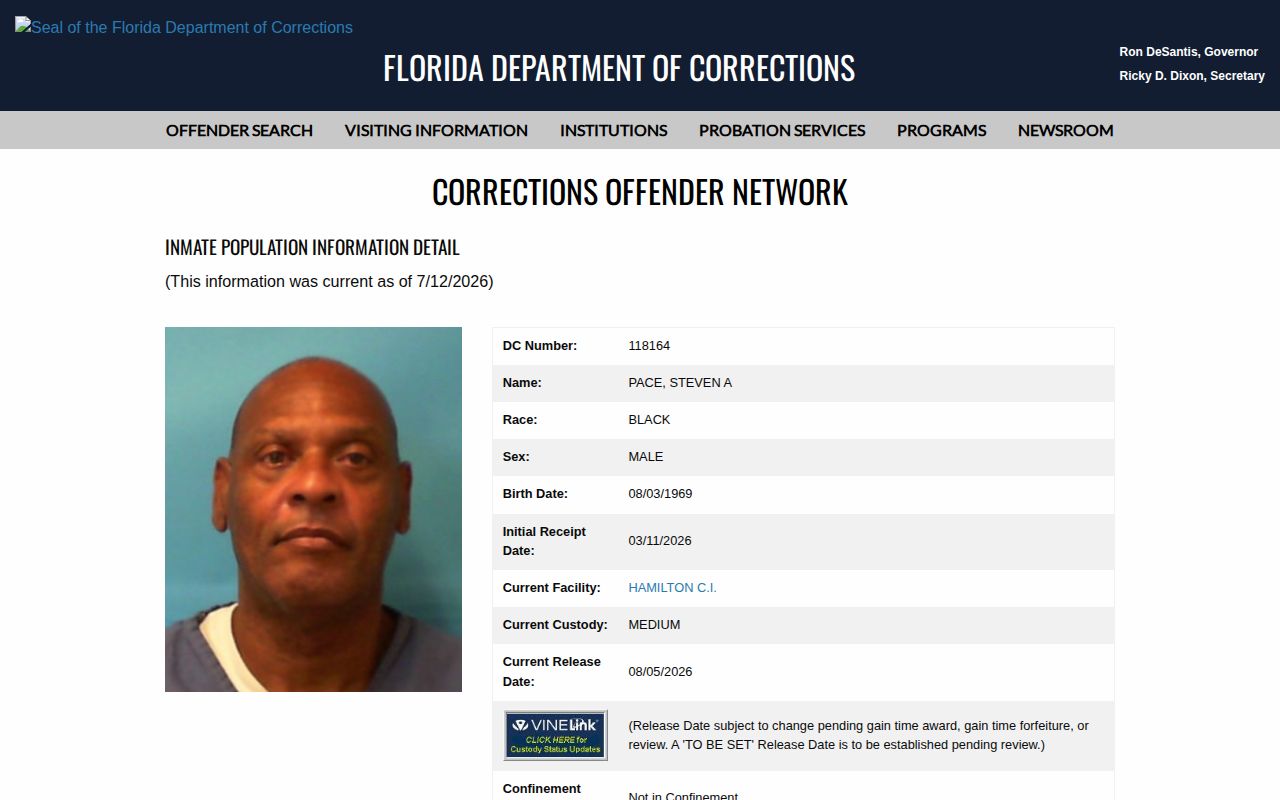
The surrounding fields help confirm that the displayed date belongs to the right person and current state-custody record.
Florida Gain Time for Gulf Releases
Florida Statutes § 944.275 requires FDC to establish a maximum sentence-expiration date after lawful credit and then a tentative release date affected by gain time. An award can move the tentative date earlier. Forfeiture can move it later. The tentative date may not extend beyond the maximum expiration date.
Gain-time rules depend on the offense date. Historical basic gain time of ten days per month generally applies within the period described for offenses from July 1, 1978 through December 31, 1993. Incentive ceilings varied across later periods. They reached up to twenty days per month before 1994, had offense-severity distinctions in the next period, and are up to ten days per month for many offenses on or after October 1, 1995. The statute also addresses meritorious gain time, a qualifying educational award, and exclusions for specified serious offenses.
The often cited 85 percent rule appears in § 944.275(4)(f). For a person governed by the post-October 1, 1995 provision, FDC may not grant gain time that causes release before service of 85 percent of the sentence imposed. Court-awarded credit for time physically incarcerated counts toward that share. The calculation is not simply the sentence multiplied by .85. Consecutive or concurrent terms, jail credit, offense-date law, exclusions, disciplinary forfeiture, and later court action still affect the operational date.
The official gain-time statute contains the date-specific framework behind FDC's tentative date.
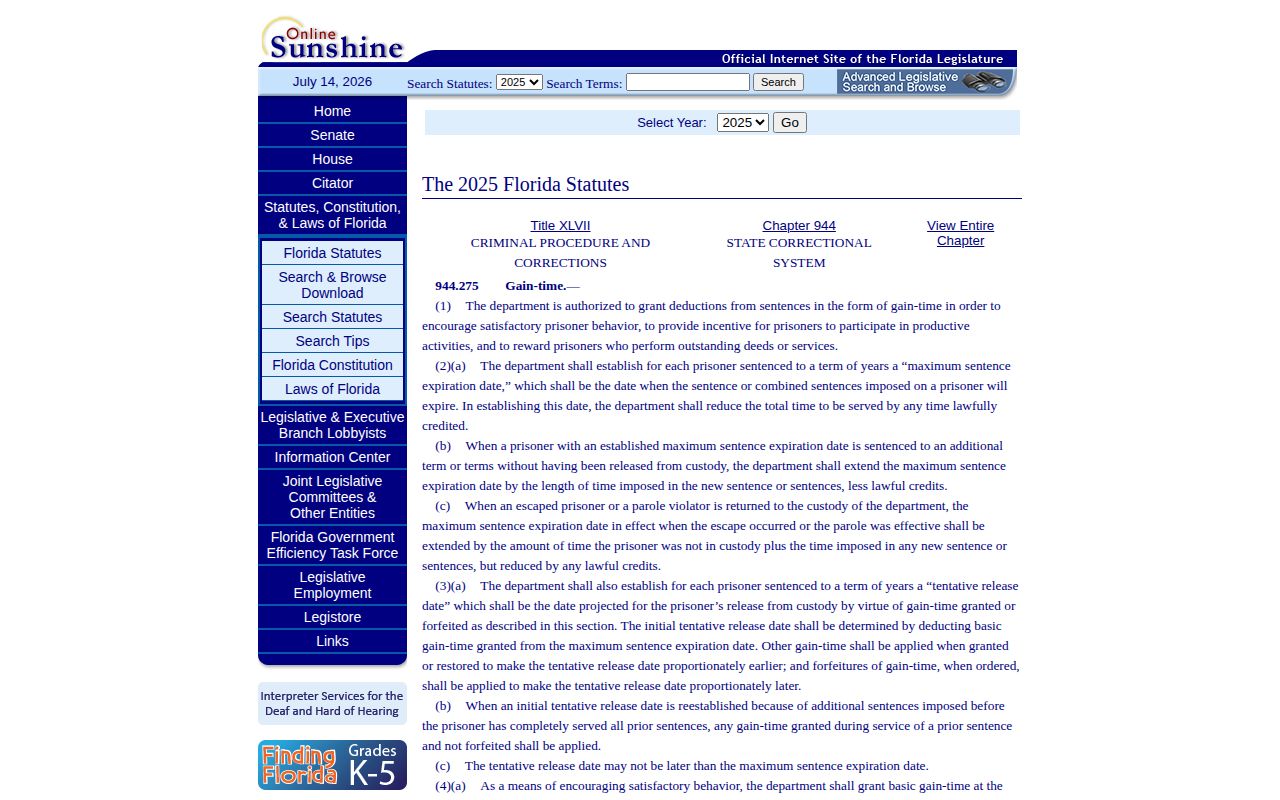
The statutory detail explains why a current date cannot be reduced to one statewide formula.
Why Gulf Release Dates Change
A date can move because the facts or legal inputs changed, not because the public screen was necessarily wrong when viewed. The best audit trail is the sentence, credit calculation, agency movement history, and later orders. The reason should come from that record rather than speculation based on two screenshots.
| Factor | Possible effect | Confirm with |
|---|---|---|
| Gain-time award | May move an FDC tentative date earlier within statutory limits | FDC sentence calculation |
| Disciplinary forfeiture | May move the date later | FDC record under §§ 944.28 and 944.281 |
| Corrected jail credit | Can change credited service and the calculation | Court order and agency calculation |
| New or corrected sentence | Can replace a prior legal input | Trial or appellate court record |
| Another commitment or hold | May prevent return to the community even when one term ends | Receiving custodian and detainer record |
| Parole or conditional action | May establish, modify, or delay an effective date | FCOR Commission Action |
| Release-plan verification | Can delay an otherwise authorized effective parole date | FCOR and FDC records |
Section 944.28 governs disciplinary forfeiture, while § 944.281 addresses a period of ineligibility to earn incentive gain time after specified violations. Section 944.70 identifies state release mechanisms across offense periods, including sentence expiration, expiration reduced by gain time, clemency, conditional release, conditional medical release, and control release. It is inaccurate to call all of them parole.
Note: A scheduled parole interview or calendar entry is not a release grant; the final Commission Action controls the outcome language.
Gulf County Jail Date Rules
County-jail good conduct follows a different statute. Florida Statutes § 951.21 provides a county-prisoner commutation framework unless the county commission discontinues or revises it. The statutory schedule permits up to five days per month in years one and two, ten days per month in years three and four, and fifteen days per month in year five and later. It also allows a possible additional local award and addresses forfeiture.
No Gulf County policy implementing, changing, or discontinuing that schedule was located. The safe method is to obtain the judgment, confirm credited time, and ask the jail for its actual calculation. Do not import FDC's Current Release Date or 85 percent explanation into a county sentence. A person awaiting trial has no good-time based sentence date to compute in the first place.
The Gulf County Clerk and jail serve different proof needs. The clerk's judgment establishes the sentence and credit ordered by the court. The jail's record shows how the local custodian applied the controlling inputs and when physical release occurred. If one term ends but another warrant or agency hold remains, the next step is a transfer, not a confirmed community release.
Confirm Gulf County Actual Release
For a state prisoner, move from the Population detail to the separate FDC Inmate Release Information Search after the expected event. The released detail uses Release Date rather than Current Release Date. Search the same DC number to keep identity stable. If the release reason matters, ask FDC or review the court and FCOR records because the public released example does not show a release reason.
For Gulf County jail custody, request the existing booking and release entry. Ask for the release date and time, release method or disposition, releasing authority, and transfer destination or receiving agency if public. The court docket can explain bond, dismissal, sentence, or commitment, but it may not show the precise physical departure time. Florida public-record law provides access to existing records subject to exemptions; it does not require the custodian to create a new release narrative.
FDC release-data questions can be directed to the Bureau of Admission and Release at (850) 488-9167 or dc.release@fdc.myflorida.com. Use the DC number and identify the exact date field believed to need explanation. For a Gulf jail record, the jail can route the request at gulfcountyjail@gulfcounty-fl.gov, while GCSO Records accepts focused public-record requests at publicrecords@gcso.fl.gov. Asking for an existing electronic record and a fee estimate keeps the request tied to records the office actually maintains.
A pending event can also be monitored through the Gulf County VINELink inmate check, but an alert remains supplementary. Compare it with the jail or FDC record. A state supervision result may begin after prison release, yet supervision is not incarceration and its termination date is not the prison release date. A federal transfer requires the BOP or responsible federal record, not Florida's projected-date field.